The Universal Law of Fasting: How Animals and Insects Reflect a Divine System

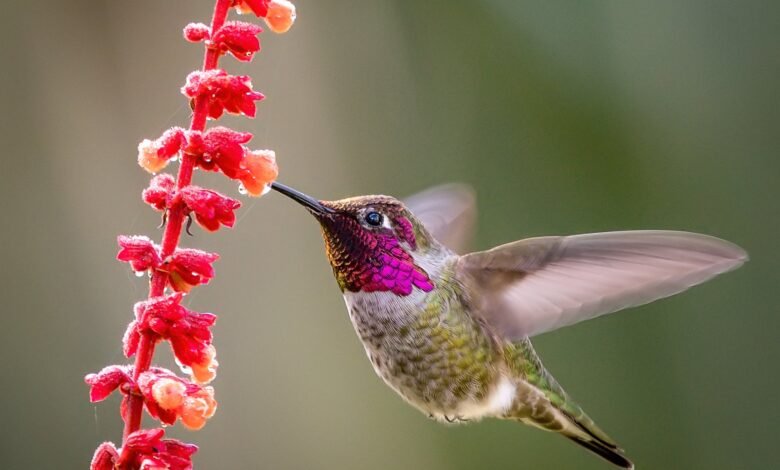
The hummingbird is a striking example of the unity of order in the universe—an example that invites deep scientific and contemplative reflection. For the Creator is One, and worship is One.
It is the only bird in the world capable of flying backward, upward, and downward, and even hovering motionless in the air like a helicopter.
Its heart beats at a rate of up to approximately 1,200 beats per minute, and its wings flap around 80 times per second, so rapidly that the human eye perceives them only as a blurred shadow.
Because of its extremely high energy consumption, the hummingbird enters at night a state resembling torpor or a form of “temporary death,” during which it dramatically lowers its heart rate and body temperature in order to conserve energy until sunrise.
This phenomenon resembles—at least in form—a kind of nightly “biological fasting,” in which activity is reduced to a minimum to sustain life for the following day.
- Bears
Bears enter hibernation for several months, during which they almost completely stop eating and drinking. Their heart rate and metabolic rate drop to very low levels, while life continues internally.
They rely on fat reserves accumulated during summer and autumn, which are gradually consumed throughout the hibernation period.
Cosmic model: A large and powerful creature does not survive through constant strength, but through the law of cycles and moderation— a phase of activity and nourishment, followed by a phase of prolonged fasting to restore balance.
- Emperor Penguins
The male emperor penguin incubates the egg during the harsh Antarctic winter, remaining standing for weeks without food, while the female travels to the sea to feed and later returns.
During this time, the male reduces activity and depends entirely on stored energy until the egg hatches.
Cosmic model: Fasting for a higher mission. The penguin suspends its immediate need for food in order to fulfill a supreme purpose: the preservation of offspring—much like humans sacrifice bodily comfort during fasting for a higher spiritual goal.
- Spiders
Some spiders, particularly females of certain species, refrain from hunting and feeding during egg-laying and incubation. They remain attached to the eggs for protection and may become severely weakened during this period.
Energy priority shifts from self-feeding to caring for the next generation.
Cosmic model: A very small creature practicing a form of “service fasting,” suspending normal nourishment to ensure safety and continuity for its offspring.
- Salmon
Salmon undertake a strenuous migratory journey from the ocean to the upper rivers where they were born in order to spawn, often dying afterward.
During this long journey, they nearly cease feeding entirely, surviving on internal energy reserves until reproduction is completed.
Cosmic model: Fasting along the path of migration—a body that endures hunger to reach its origin and fulfill its mission, symbolically resembling the human journey from this world to the Hereafter, during which many desires are left behind.
- Snakes
Many snakes enter winter or summer dormancy depending on climate, during which they completely abstain from food for weeks or even months.
They lower body temperature and metabolic activity, surviving on minimal energy.
Cosmic model: A powerful predator that nonetheless submits to the law of temporary restraint, maintaining ecological balance so that predation does not become limitless.
- Frogs and Amphibians
Some frogs hide in mud or beneath rocks during cold winters or droughts, entering a dormant state in which feeding nearly stops for extended periods.
All vital functions slow dramatically until harsh environmental conditions pass.
Cosmic model: Fragile life sustained through biological patience—unable to resist cold or drought by force, it survives by temporarily shutting down.
Thus, “biological fasting” among these creatures (bears, penguins, spiders, salmon, snakes, frogs…) represents a shared cosmic mechanism characterized by:
Suspension or reduction of feeding
Reduction of activity and metabolism
Service to a higher purpose: survival, reproduction, incubation, or endurance through harsh conditions
Biological Fasting in Insects
Even insects exhibit phases that can be described as forms of biological fasting.
- Pupal Stage in Holometabolous Insects
Examples include butterflies, flies, beetles, and silkworms.
During the pupal stage, insects completely stop feeding inside the cocoon and rely solely on energy stored during the larval phase.
Profound bodily transformations occur during this time (from larva to adult), resembling a complete fast serving the process of metamorphosis.
- Dormancy / Diapause in Insects
Some insects enter states of dormancy or diapause during extreme cold, drought, or food scarcity.
Movement becomes minimal or ceases altogether, feeding stops, and survival depends on stored fat reserves.
Conclusion
Just as large animals fast during hibernation, migration, or incubation, insects also undergo complete abstinence from food for days or weeks—within a single cosmic system serving survival, transformation, and growth.
These models can be employed in our writings during the month of Ramadan to demonstrate—both to Muslims and to the wider global audience—that human fasting is part of a universal cosmic system. In humans, fasting rises from the level of biological survival observed in animals and plants to the level of worship, consciousness, and intentional devotion—even though animals and insects are, as the Qur’an states, “communities like yourselves.”
With best regards,
Dr. Mohamed Borbab
